DIGITAL HEALTH PERSPECTIVE · 7 MIN READ
The Gulf Is Building a $24B Digital Health Economy. Cyber Resilience Is the License to Operate It.
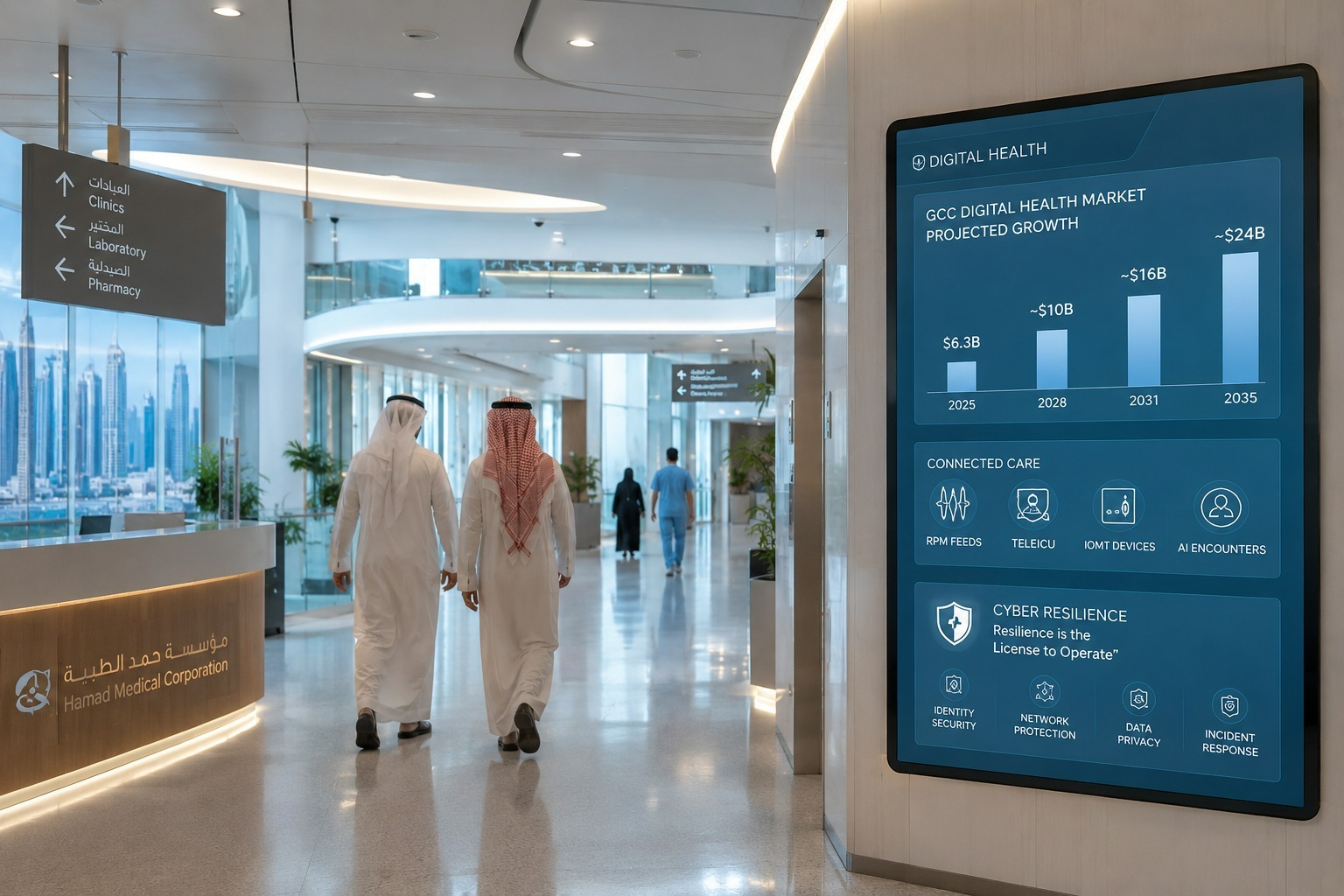
A new analysis published this week projects the GCC digital health market growing from $6.3 billion to nearly $24 billion by 2035, with Qatar emerging as the region's testing ground for connected care. Meanwhile, the threat data coming out of North America should give every health system board pause.
GCC DIGITAL HEALTH MARKET · PROJECTED GROWTH
$6.3B
2025
~$10B
2028
~$16B
2031
~$24B
2035
1. Growth casts a shadow, measured in attack surface
Qatar's healthcare market is forecast at $15.2 billion in 2026, and every driver of that growth, RPM feeds, TeleICU, IoMT devices, ambient AI encounters, is also a new endpoint. Having commissioned 2,000+ medical devices in a single hospital activation, the pattern is consistent: connectivity scales faster than the discipline to secure it, unless you make that discipline a design constraint from the start.
GCC · IoMT · Qatar Vision 2030
2. North America is our early warning system
US healthcare ransomware attacks are up 14% this year, averaging 2.3 attacks per day, with the average hospital incident now costing roughly $10.9 million. The entry point is rarely an unknown exploit. It is a phishing email that beat an undertrained staff member, on a network that was never segmented. The GCC should treat these numbers as a preview, not someone else's problem.
Ransomware · Phishing Kits
3. Cyber recovery is a clinical function, not an IT function
When systems go down, care is delayed, full stop. It is encouraging that the US Health Sector Coordinating Council and Health-ISAC are convening specifically on incident response and recovery. That is the right framing: rehearse a cyber event the way you rehearse a code blue. Downtime procedures belong in clinical operations manuals, not just IT runbooks.
Incident Response · Clinical Continuity
4. In greenfield builds, security is poured with the foundation
Activating hospitals across Qatar, Iraq, Algeria, Libya, and Kazakhstan teaches the same lesson every time: the cheapest security control is the one specified before activation. Network segmentation, identity architecture, and recovery objectives have to sit in the activation plan alongside the EHR build. Retrofitting them into a live hospital costs multiples more, in money and in risk.
Hospital Activation · Security By Design
To my fellow CIOs and CISOs: does your board know how many hours it would take to restore clinical operations after an attack? If the answer is "we are compliant," that is not an answer.
Qatar and the wider Gulf have earned the right to be optimistic about digital health. The market data backs it up, and the pace of activation across the region backs it up further. But a $24 billion market is also a $24 billion attack surface if resilience is treated as a compliance checkbox rather than a design input. The systems being built this year are the ones that will carry that growth. Whether they carry it safely comes down to decisions being made now, not decisions deferred until after go-live.
Healthcare Cybersecurity · Cyber Resilience · Digital Health · GCC Healthcare · Health IT
Lusail Advisory
Healthcare, Technology & AI Advisory · Doha, Qatar
info@lusailadvisory.com